
LYCOXANTHIN
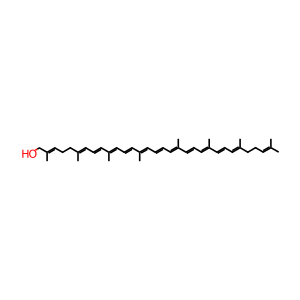
Drag to rotate, scroll to zoom
Drawn and modelled with RDKit, 3D viewer 3Dmol.js. PubChem CID 5281245
Name
LYCOXANTHIN
IUPAC name
(2E,6E,8E,10E,12E,14E,16E,18E,20E,22E,24E,26E)-2,6,10,14,19,23,27,31-octamethyldotriaconta-2,6,8,10,12,14,16,18,20,22,24,26,30-tridecaen-1-ol
SMILES
CC(=CCC/C(=C/C=C/C(=C/C=C/C(=C/C=C/C=C(\C)/C=C/C=C(\C)/C=C/C=C(\C)/CC/C=C(\C)/CO)/C)/C)/C)C
Molecular formula
C40H56O
Molecular weight
552.89 g/mol
Monoisotopic mass
552.4331 Da
Chemical classification: NPClassifier (Kim et al., 2021)
| Plant | Plant part | Amount | Reference |
|---|---|---|---|
| Calendula arvensis (Vaill.) L. | flower | - |
Baraud, J. (1958). Carotenoids of the flowers of Calendula and of the fruits of Tamus, Rosa, Malpighia, Physalis. Rev Gen Bot, 65, 221
|
| Dioscorea communis (L.) Caddick & Wilkin | fruit | - |
Baraud, J. (1958). Carotenoids of the flowers of Calendula and of the fruits of Tamus, Rosa, Malpighia, Physalis. Rev Gen Bot, 65, 221
|
| Equisetum telmateia Ehrh. | leaf | - |
Czeczuga, B. (1985). Carotenoids in sixty-six representatives of the Pteridophyta. Biochem Syst Ecol, 13(3), 221-230 doi:10.1016/0305-1978(85)90030-4
|