
HELICHRYSOSIDE
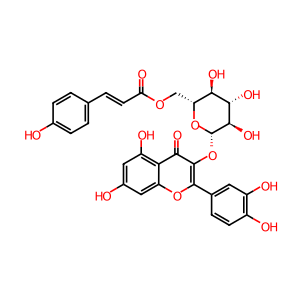
Drag to rotate, scroll to zoom
Drawn and modelled with RDKit, 3D viewer 3Dmol.js. PubChem CID 5317991
Name
HELICHRYSOSIDE
Also reported as
QUERCETIN-3-O-DI-PARA-COUMAROYL-GLUCOSIDE
IUPAC name
((2R,3S,4S,5R,6S)-6-((2-(3,4-dihydroxyphenyl)-5,7-dihydroxy-4-oxo-4H-chromen-3-yl)oxy)-3,4,5-trihydroxytetrahydro-2H-pyran-2-yl)methyl (E)-3-(4-hydroxyphenyl)acrylate
SMILES
C1=CC(=CC=C1/C=C/C(=O)OC[C@@H]2[C@H]([C@@H]([C@H]([C@@H](O2)OC3=C(OC4=CC(=CC(=C4C3=O)O)O)C5=CC(=C(C=C5)O)O)O)O)O)O
Molecular formula
C30H26O14
Molecular weight
610.52 g/mol
Monoisotopic mass
610.1323 Da
Chemical classification: NPClassifier (Kim et al., 2021)
| Plant | Plant part | Amount | Reference |
|---|---|---|---|
| Crocus vernus (L.) Hill | flower | - |
Duke, James A. 1992. Handbook of phytochemical constituents of GRAS herbs and other economic plants. Boca Raton, FL. CRC Press.
|
| Eryngium campestre L. | aerial parts | - |
Kartnig, T., Wolf, J. (1993). Flavonoids from the aboveground parts of Eryngium compestre. Planta Med, 59(3), 285-286
|