
DHURRIN
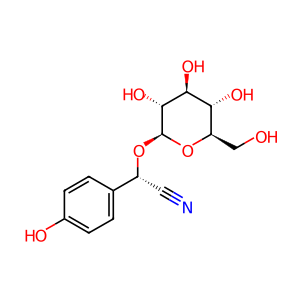
Drag to rotate, scroll to zoom
Drawn and modelled with RDKit, 3D viewer 3Dmol.js. PubChem CID 161355
Name
DHURRIN
IUPAC name
(S)-2-(4-hydroxyphenyl)-2-(((2R,3R,4S,5S,6R)-3,4,5-trihydroxy-6-(hydroxymethyl)tetrahydro-2H-pyran-2-yl)oxy)acetonitrile
SMILES
C1=CC(=CC=C1[C@@H](C#N)O[C@H]2[C@@H]([C@H]([C@@H]([C@H](O2)CO)O)O)O)O
Molecular formula
C14H17NO7
Molecular weight
311.29 g/mol
Monoisotopic mass
311.1005 Da
Pathway:
Superclass:
Class:
Glycoside:
Yes
Chemical classification: NPClassifier (Kim et al., 2021)
| Plant | Plant part | Amount | Reference |
|---|---|---|---|
| Juncus articulatus L. subsp. articulatus | - | - |
Seigler, D.S. (1976). Plants of the northeastern united states that produce cyanogenic compounds. Econ Bot, 30, 395-407 doi:10.1007/bf02904662
|
| Ranunculus repens L. | leaf | - |
Tjonsiefat, L. (1979). Contribution to the knowledge of cyanogenesis in angiosperms. cyanogenesis in Ranunculaceae. Proc K Ned Akad Wet Ser C, 82, 197-209 doi:10.1055/s-0028-1097195
|
| Sorghum halepense (L.) Pers. | rhizome | - |
Nicollier, G.F., Pope, D.F., Thompson, A.C. (1983). Biological activity of dhurrin and other compounds from johnson grass (Sorghum halepense). J Agr Food Chem, 31(4), 744-748 doi:10.1021/jf00118a016
|
| Triticum aestivum L. subsp. aestivum | seedling | - |
Duke, James A. 1992. Handbook of phytochemical constituents of GRAS herbs and other economic plants. Boca Raton, FL. CRC Press.
|