
CIRSILINEOL
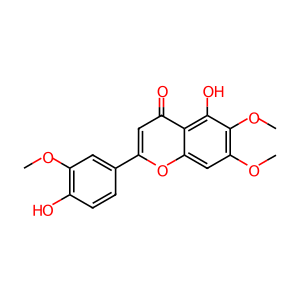
Drag to rotate, scroll to zoom
Drawn and modelled with RDKit, 3D viewer 3Dmol.js. PubChem CID 162464
Name
CIRSILINEOL
IUPAC name
5-hydroxy-2-(4-hydroxy-3-methoxyphenyl)-6,7-dimethoxy-4H-chromen-4-one
SMILES
COC1=C(C=CC(=C1)C2=CC(=O)C3=C(C(=C(C=C3O2)OC)OC)O)O
Molecular formula
C18H16O7
Molecular weight
344.32 g/mol
Monoisotopic mass
344.0896 Da
Chemical classification: NPClassifier (Kim et al., 2021)
| Plant | Plant part | Amount | Reference |
|---|---|---|---|
| Artemisia annua L. | - | 60 ppm |
Duke, James A. 1992. Handbook of phytochemical constituents of GRAS herbs and other economic plants. Boca Raton, FL. CRC Press.
|
| Artemisia annua L. | aerial parts | - |
Wright,C.W.(Ed)2002.Medicinal&Aromatic Plants-Industrial Profiles.Artemisia.344pp.Maffei,M.(Ed)2002.Vetiveria.The Genus Vetiveria.Taylor&Francis.NY,NY.191pp.Southwell,I.,Lowe,R.(Eds)1999.Tea Tree.The Genus Melaleuca.Harwood Acad.Pub.Amsterdam,Netherlands.
|
| Artemisia annua L. | cell culture | 500 ppm |
Duke, James A. 1992. Handbook of phytochemical constituents of GRAS herbs and other economic plants. Boca Raton, FL. CRC Press.
|
| Veronica persica Poir. | aerial parts | - |
Saracoglu, I., Harput, S.U., Ogihara, Y. (2004). Acylated flavone glycosides from, Veronica pectinata var. glandulosa and V. persica Turkish J Chemistry, 28(6), 751-759
|